Abstract
The rapid advancement of generative AI technology has been driving the democratization of software development. However, current AI coding tools (Bolt.new, v0.dev, Cursor, etc.) are all “tools built by engineers, for engineers,” fundamentally lacking dialogue logic for non-technical users. This paper analyzes the structural challenges of conventional AI tools from a technical perspective, then argues why the “Mori Method” of vibe coding can overcome these challenges. In particular, we demonstrate that the Mori Method’s competitive advantage stems from the author’s compound reference base spanning infrastructure operations, enterprise sales, educational design, and marketing — a combination that typical engineers simply do not possess.
Chapter 1: The Problem — Who Is Generative AI Writing Code For?
1-1. The Current State and Market Size of AI Coding Tools
Since 2025, the AI code generation market has exploded. GitHub Copilot is used by over 100 million developers, and tools like Bolt.new, v0.dev, Replit Agent, and Cursor continue to emerge. Japan’s domestic DX-related investment reached 5.2759 trillion yen in fiscal 2024, with projections doubling to 9.2666 trillion yen by fiscal 2030[1].
Yet these tools share a common structural flaw: they all assume the user can already write code.
1-2. The Absence of Dialogue Logic — The Greatest Technical Challenge in AI Coding
Analyzing the architecture of current AI coding tools, their processing flow can be abstracted as follows:
Text → Code Conversion
* No dialogue logic exists
The fundamental problem in this pipeline is that no “Dialogue Logic” exists between user input and code generation.
“Dialogue Logic” here does not refer to a mere chat interface. It encompasses a structured intent-elicitation process with three elements:
- Progressive Intent Extraction — A process that progressively concretizes requirements that users themselves cannot yet clearly articulate, through staged questioning
- Context-Adaptive Branching — Logic where the next question dynamically changes based on user responses, following the optimal information-gathering path
- Non-Technical Language Mapping — A layer that converts sensory expressions like “warm feeling” or “trustworthy atmosphere” into technical specifications (color palettes, typography, layout patterns, etc.)
Current tools lack all three. Both Bolt.new and v0.dev ask users “What do you want to build?” but never ask “Why do you want to build it?”, “Who do you want to reach?”, or “What feelings do you want to convey?”
In other words, current AI coding tools are “code-generating machines,” not “partners that give form to human aspirations.”
1-3. Technical Limitations of Template-Dependent Architecture
No-code platforms like Wix, Shopify, and STUDIO employ template-based architectures. Their processing model is as follows:
Finite set T = {t1, t2, … tn}
* Output diversity is constrained by |T|
The problem with this model is mathematically obvious. Since the template set T is finite, output diversity is constrained by the cardinality of T (|T|). From 100 templates, at most 100 pattern variations emerge. Even with 100,000 users, outputs converge to 100 patterns.
Human aspirations, on the other hand, exist in a continuous space. A discrete template set fundamentally cannot capture this continuity.
Chapter 2: Theoretical Foundation of the Mori Method Vibe Coding
2-1. Core Principle — Intent-First Design
The essence of the Mori Method vibe coding lies in placing the starting point of software generation not in technical specifications but in “human intent”.
The conventional engineer’s approach begins with “What (what to build).”
Engineer: “Do you want to build a landing page? An e-commerce site?”
Non-technical user: “Landing page? E-commerce? I have no idea what those are.”
The Mori Method begins with “Why (why do you want to do this).”
Mori Method: “What do you want to achieve?”
–> “I want to sell handmade accessories as a side business”
–> “I want to sell my English teaching materials online”
–> “I want more people to know about my shop”
This difference is not merely a UX improvement. It is a fundamental transformation of the software generation pipeline architecture itself.
2-2. Technical Design of Dialogue Logic — Wizard Architecture
The most critical element in the technical implementation of the Mori Method is a wizard architecture that uses absolutely zero technical terminology. This wizard consists of 5 steps.
Step 1: Intent Classification
Q1: What do you want to achieve?
- I want to introduce my shop or service
- I want to sell physical products
- I want to sell digital content
- I want to showcase my works / portfolio
- I want to attract people to my events or classes
- I’m not sure yet, but I want to create something
No technical terms like “LP,” “e-commerce,” or “CMS” appear here. However, internally, each option is mapped to a site type (LP / EC / Portfolio / Event, etc.), determining subsequent question branches and initial generation parameters.
Steps 2-4: Context-Adaptive Drilling
Questions dynamically branch based on the user’s selection.
Example 1: “I want to sell physical products” –> Handmade accessories
Q2: What kind of products? –> “Handmade accessories”
Q3: What style? –> “Natural and warm feeling”
Q4: Target audience? –> “Women in their 20s-30s”
Q5: Brand name? –> “hana accessory”
Example 2: “I want to sell digital content” –> English materials
Q2: What kind of content? –> “English teaching materials”
Q3: For whom? –> “Working adults aiming for TOEIC 600”
Q4: Price range? –> “Around $20-35”
Q5: Your strength? –> “10 years of overseas work experience”
The design of this branching logic is the technical core of the Mori Method. What questions to ask someone who “wants to sell handmade accessories” differs fundamentally from those for someone who “wants to sell English materials.” Conventional tools lack this branching, presenting all users with the same input form (site name, color, logo).
Step 5: AI Generation — “This IS my service!”
Once all answers are gathered, the AI executes the following process:
Claude API (tool_use enabled)
Instant Preview Display
Every person produces a different output. Not a template derivative, but a one-of-a-kind creation born from each individual’s aspirations.
Chapter 3: Why Conventional AI Tools Cannot Achieve This Design
3-1. The Structural Problem of Engineer’s Bias
Bolt.new, v0.dev, Cursor — these tools are designed and developed by brilliant engineers in Silicon Valley. They represent the world’s highest technical standards, yet they possess a critical blind spot.
The unconscious assumption that “users understand technology the same way we do.”
This is not malice but a cognitive bias problem. It is structurally difficult for an engineer with a computer science degree and 10+ years of coding experience to imagine the feelings of someone who “doesn’t know the difference between a landing page and an e-commerce site.”
As a result, these tools’ UIs follow designs like:
- A prompt input field displays “Describe what you want to build” — in English, assuming users already know what they want to create
- Framework selection (React / Vue / Svelte) is required — meaningless to non-technical users
- Generated code is displayed directly — terrifying for people who cannot read code
Current tools claim to “democratize technology” while filtering for technical literacy at the entrance. This is not a design flaw but a structural problem rooted in the designers’ limited reference base.
3-2. Technical Barriers to Implementing Dialogue Logic
Even if the above problem is recognized, implementing dialogue logic faces technical barriers.
Barrier 1: Breadth of Domain Knowledge
Designing wizard branching logic requires knowing what questions to ask to produce optimal output for each persona — someone selling handmade accessories, someone selling English materials, someone promoting a local restaurant. This cannot be obtained from pure technical knowledge. It requires practical experience in sales, marketing, education, and business development.
Barrier 2: Sensory-to-Technical Specification Conversion
“Natural and warm feeling” — Converting this to a color palette (#F5E6D3, #8B7355, #D4A574), font (Noto Serif JP), and spacing design (generous padding, relaxed line-height) requires understanding both design sensibility and technical implementation.
Barrier 3: Full-Stack Technical Implementation
Outputting dialogue results as a “working website” requires not just frontend (HTML/CSS/JavaScript) but also backend (PHP/Laravel), infrastructure (Nginx/DNS/SSL), and databases (MariaDB/Redis). E-commerce needs payment integration, booking needs calendar APIs, and contact forms need SMTP configuration.
Professionals who can simultaneously overcome all three barriers are extremely rare in the industry.
Chapter 4: The Mori Method’s Decisive Advantage — Reference Asymmetry
4-1. Reference Structure of a Typical Engineer
A typical software engineer’s reference (experience and knowledge base) has the following structure:
| Domain | Item | Proficiency |
|---|---|---|
| Technical Domain (Deep) | Frontend or Backend | Advanced |
| Specific Framework | Advanced | |
| Specific Language | Advanced | |
| Adjacent Domain (Shallow) | UI/UX | Basic |
| Project Management | Basic | |
| Missing Domain | Sales / Client Relations | No Experience |
| Marketing / Advertising | No Experience | |
| Educational Design / Curriculum | No Experience | |
| Enterprise Business Strategy | No Experience | |
| Infrastructure Operations | Fragmented |
Engineers possess deep knowledge in their specialty, but areas like “what customers truly want,” “how to ask the right questions to uncover real needs,” and “how to create output that moves people” lie outside their reference.
4-2. The Compound Reference Structure of the Mori Method
In contrast, the author’s reference base has the following compound structure:
| Domain | Item | Proficiency |
|---|---|---|
| Technical (Full-Stack Production) | Frontend (HTML/CSS/JS/Vue) | Production |
| Backend (PHP/Laravel) | Production | |
| Infrastructure (Nginx/Ubuntu/DNS/SSL) | Production | |
| Database (MariaDB/Redis) | Production | |
| Security (fail2ban/ufw/WAF) | Production | |
| AI Integration (Claude API/tool_use) | Production | |
| Business (Practical Experience) | Enterprise Sales (Listed Companies to SMBs) | Experienced |
| DX Transformation Consulting | Experienced | |
| Ad Operations (TikTok/SNS Marketing) | Experienced | |
| Pricing Design / Revenue Model Building | Experienced | |
| Branding / Landing Page Design | Experienced | |
| Education (Curriculum Design) | 12-Month Course Pack Design | Designed & Running |
| Staged Learning Model Design | Designed & Running | |
| Non-Technical Learner Materials | Designed & Running | |
| Mentoring & Review Practice | Designed & Running | |
| Customer Understanding | Working with “I don’t know what I want” clients | Field Experience |
| Converting sensory requests to tech specs | Field Experience | |
| Understanding solo entrepreneur challenges | Field Experience | |
| Understanding the psychology of non-technical people | Field Experience |
This compound reference is the decisive source of the Mori Method’s competitive advantage.
Designing dialogue logic requires not only technical skill but also “the ability to listen,” “the ability to empathize,” and “the ability to understand business.” These capabilities cannot be learned from books or online courses — they can only be acquired through practical experience.
4-3. How Reference Asymmetry Creates Design Philosophy Differences
This reference gap manifests throughout tool design. Here are concrete examples:
Table: Design Decisions Shaped by Reference Differences
Display prompt input field
Display wizard (step-by-step Q&A)
Show stack trace
“Something went wrong. Let me fix it.”
Show code in editor
Preview only (code stays behind the scenes)
“Select site type”
“What do you want to achieve?”
“Deploy complete”
“This IS my service!”
“Edit the code”
“Share with friends”
These differences are not about technical skill. They are about “whose perspective drives the design” — and that perspective is determined by the designer’s reference base.
Chapter 5: Technical Implementation — VibeCoder System Architecture
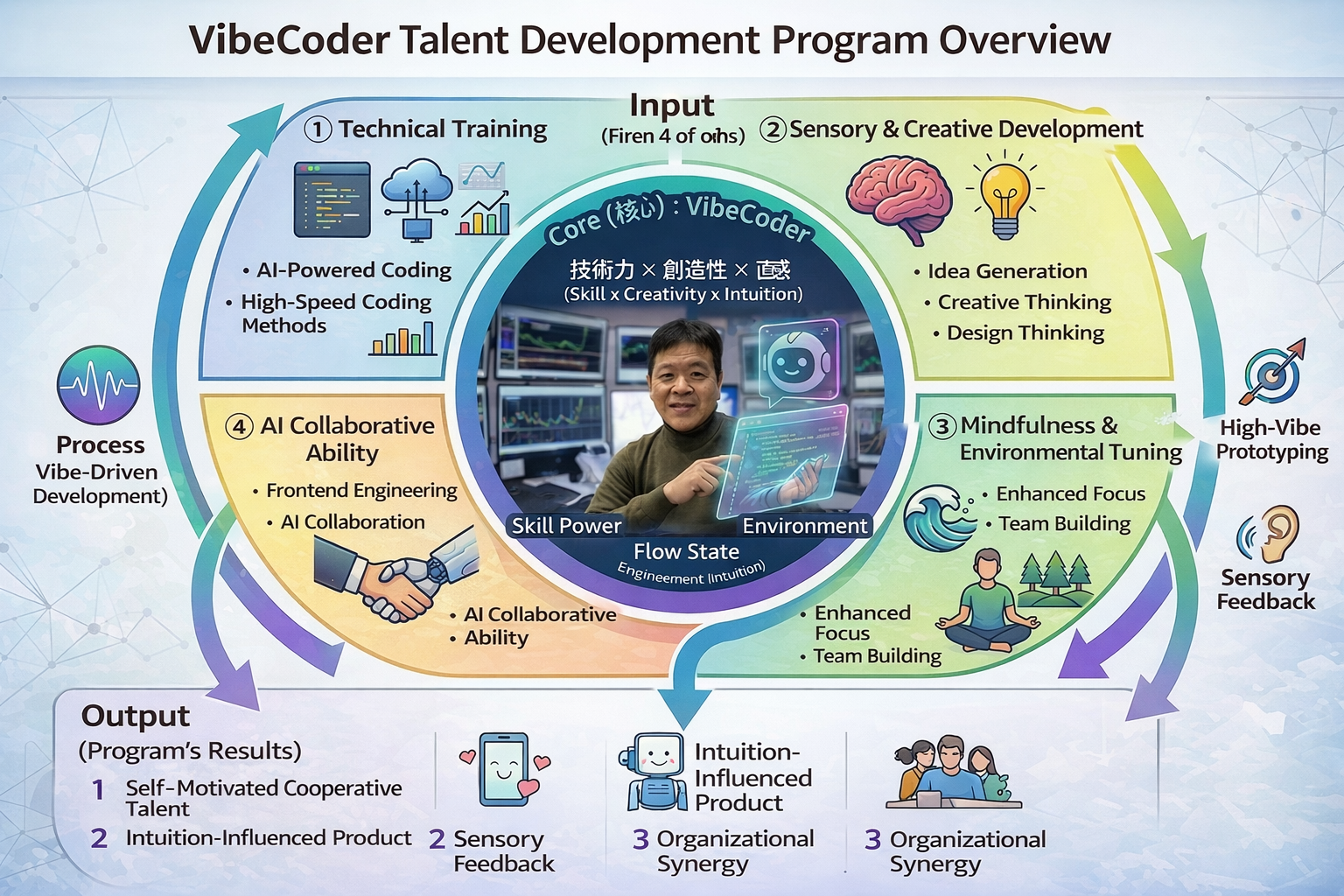
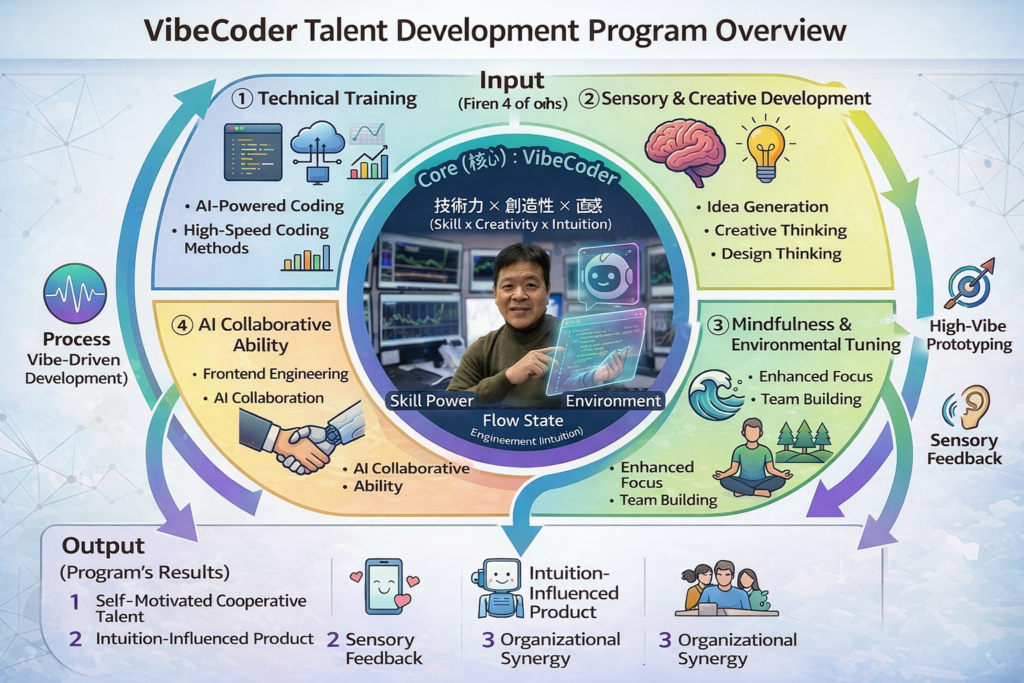
Figure 1: VibeCoder Human Resource Development Program — A training framework with Skill x Creativity x Intuition at its core
5-1. Three-Layer Prompt Instruction System
In the technical implementation of the Mori Method, we designed a “Three-Layer Prompt Instruction System” adapted to user proficiency levels. This is also an educational engineering approach enabling non-technical users to progressively develop AI dialogue skills.
Layer 1: Quick Prompts (One-Click Instructions)
For first-time users, buttons with pre-optimized embedded prompts are presented. Users simply click “Create a landing page,” and a detailed prompt is sent to the AI behind the scenes:
(One Click)
“Please create a responsive landing page. Include a header, hero section, features section (3 items), testimonials, CTA, and footer…”
Users don’t even need to know the concept of “prompts.”
Layer 2: Prompt Templates (Category-Based Instructions)
For intermediate users, category-based templates are provided. Users simply fill in proper nouns (company name, colors, service name, etc.) and an optimized prompt is auto-generated.
Layer 3: Project Brief (Requirements Editor)
For advanced users, a structured form (site name, industry, purpose, atmosphere, colors, reference sites, etc.) is provided. Form contents are automatically converted into AI prompts and referenced throughout the project.
This three-layer structure is based on Scaffolding Theory in educational engineering. Beginners gain successful experiences through quick prompts and gradually learn to instruct AI in their own words.
5-2. AI Orchestrator — tool_use Loop Architecture
VibeCoder, the technical foundation of the Mori Method, implements an autonomous code generation loop using Claude API’s tool_use capability.
Claude API call (tool_use enabled)
| ReadFile | Read existing files |
| WriteFile | Create new files |
| EditFile | Partial edits to existing files |
| ListFiles | Understand directory structure |
| SearchFiles | Search within code |
tool_result back to APICrucially, this loop operates autonomously without user intervention. A user simply says “add a contact form,” and the AI reads the necessary files, generates HTML, adjusts CSS, implements form validation, and displays the completed preview.
5-3. Security Architecture — Project Isolation and Access Control
The design of non-technical users running AI on their own VPS carries significant security challenges. The Mori Method implements multi-layered defense:
- Path Traversal Prevention — Complete blocking of access outside the project directory via
realpath() - Command Whitelist — Only allowed commands (npm install, git init, etc.) can execute.
rm -rf,sudo,chmod 777, etc. are prohibited - API Key Encryption — AES-256 server-side encryption. Frontend shows masked display only
- Execution Limits — 120-second timeout, 50KB max output, project directory scope only
Chapter 6: Competitive Analysis — Technical Comparison with Existing Tools
Most notably, no AI coding tool in the world currently possesses both “dialogue logic” and “education features.” This is not coincidental — as discussed above, no one in the industry has possessed the reference base necessary to design them.
Chapter 7: Educational Engineering Perspective — From “I Can Build” to Independence
7-1. Three-Stage Learning Model
The Mori Method vibe coding is designed not merely as a tool but as a human resource development program.
- Stage 1: “I Can Build” Experience in SaaS Environment — Experience AI-powered web development using only a browser. No terminal, no technical knowledge required. The top priority is the successful experience of “I did it myself!”
- Stage 2: Practical Skills Through Assignments — Through diverse assignments (WordPress builds, Laravel development, HTML/CSS creation), learners develop “what to tell the AI” skills (= prompt competency). Accompanied by Mori’s security checks, reviews, and advice.
- Stage 3: Independence on Your Own VPS — Contract your own VPS, set up Claude Code, and practice in a production environment. At this point, the learner becomes a self-sufficient “Vibe Coder” capable of building their own business.
7-2. Value That Remains After Graduation
The biggest problem with conventional “school-type” programming education is that after graduation, the school’s tools and servers become unavailable. In the Mori Method, all data, code, and environments exist on the user’s own VPS, so deliverables remain completely intact even after leaving the platform.
Eliminating vendor lock-in is also a matter of educational integrity.
Chapter 8: Social Impact and Outlook
8-1. Structural Resolution of the Digital Divide
Until now, there were only three options for having a website:
- Learn the technology (months to years of learning cost)
- Hire a technologist (tens of thousands of dollars in monetary cost)
- Compromise with templates (cost of losing individuality)
The Mori Method vibe coding presents a fourth option: “Just share your aspirations, and have your own unique website.” Local shop owners, stay-at-home parents, retirees starting a hobby — anyone who can articulate “what they want to do” can participate in the digital world.
8-2. Implications for the Software Industry
In fiscal 2025, software industry bankruptcies are on pace to hit a 10-year high[2]. “Just writing code” jobs are being rapidly replaced by AI.
However, from the Mori Method perspective, the value of technologists isn’t disappearing — the locus of value is shifting. From “the ability to write code” to “the ability to give form to human aspirations through technology.” Coexisting with AI while creating value in domains only humans can inhabit — empathy, understanding, creation — that is the vision of a Vibe Coder.
Conclusion
This paper’s arguments are summarized as follows:
- Structural challenges of current AI coding tools: The absence of dialogue logic. No mechanism exists to progressively elicit user intent, and technical literacy is implicitly required.
- The Mori Method vibe coding proposal: Based on Intent-First Design, an architecture enabling non-technical users to produce “their own unique deliverables” through zero-technical-jargon dialogue wizards and autonomous AI generation loops.
- Source of advantage: The Mori Method’s advantage stems not from mere technical skill, but from a compound reference base spanning infrastructure operations, enterprise sales, educational design, and marketing. This combination cannot be acquired through a typical engineer’s career path, and it is precisely this that makes dialogue logic design possible.
- Social significance: A transition from the world of “choose a template and write code” to “give form to your aspirations.” The structural resolution of the digital divide and the redefinition of value standards in the software industry.
Every person has their own aspirations, and every person produces a different output. That is the world the Mori Method vibe coding aims to create.
Footnotes
[1] Fuji Chimera Research Institute, “Domestic DX-Related Investment Market Survey 2025”
[2] Tokyo Shoko Research, “Software Industry Bankruptcy Trends Survey 2025”
Author: Mori (CEO of AI Bridge / VibeCoder Developer)
First published: March 18, 2026